

Free Plat-Dev-210 Exam Files Downloaded Instantly 100% Dumps & Practice Exam
Free Exam Updates Plat-Dev-210 dumps with test Engine Practice
NEW QUESTION # 32
Refer to the exhibit below. What is the marge code needed for this integration procedure structure to pass a CaseNumber node from the DRReadCase DataRaptor Extract Action to the HTTP Action's HTTP URL?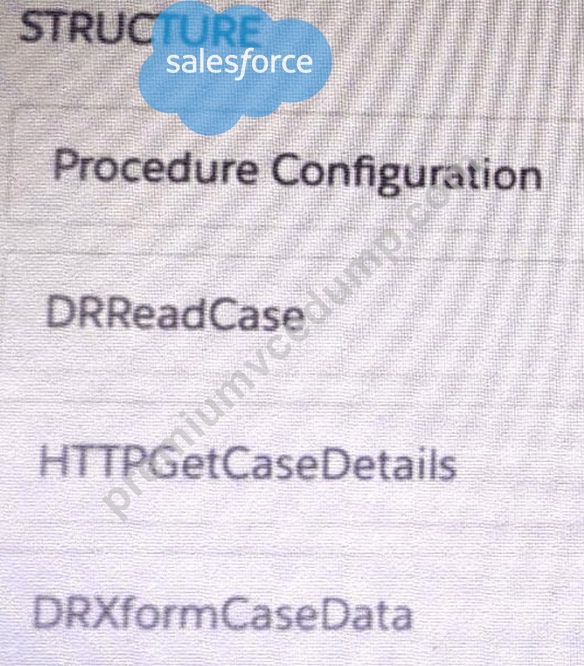
- A. ((DRRCase, CaseNumber))
- B. MTTOPDetCaseDetail: CaseNumber%
- C. %DRReadCase: CaseNumber%
- D. ((CaseNumber))
Answer: C
Explanation:
The merge code syntax for passing data from a DataRaptor Extract Action to an HTTP Action is % DataRaptorName: NodeName%. In this case, it is %DRReadCase: CaseNumber%.
NEW QUESTION # 33
A developer is creating a Flex Card for a new Community page. The FlexCard will display case information along with action to close the case and update the case. And it will be styled using the Community's theme.
What must be developer do to configure the FlexCard for deployment in a community?
- A. Add the FlexCard's API name to FlexCard Player component
- B. Configure the Component visibility in the custom Component.
- C. Set the Target property in publishing Options to the Community page''
- D. Set the Developer property in Card Configuration to ''Community''
Answer: C
Explanation:
The Target property in publishing Options determines where the FlexCard will be displayed. Setting it to the Community page will make the FlexCard available in the community
NEW QUESTION # 34
A developer needs to display the following information together on one FlexCard:
* Account name, address, phone number, website
* Primary contact first name, contact name, address, phone number, email The account information must always be visible, and the contact information should only be visible as needed by the user.
What approach should the developer use to display the contact information on the card?
- A. Use a Data table element
- B. Set the class'' collapsible'' on the block element
- C. Use a conditional FlexCard State
- D. Set the collapsible property on the block element
Answer: D
Explanation:
Setting the collapsible property on the block element allows the user to expand or collapse the block as needed. Using a Data table element is not suitable for displaying contact information. Setting the class'' collapsible'' on the block element has no effect. Using a conditional FlexCard State requires a condition to be met, not a user choice.
NEW QUESTION # 35
A developer needs to use the CONTIF function to process data entered by the user in an OmniScript. The output of the function needs to be displayed to the user immediately in the current step.
Based on best practice, what element should the developer use this function in?
- A. A Range element
- B. A Set Values element
- C. A Calculation Action element
- D. A formula element
Answer: D
Explanation:
A formula element allows the developer to define formulas using functions and operators to manipulate data in an OmniScript. The output of the formula element can be displayed to the user immediately in the current step using a display element. The CONTIF function counts how many times a value appears in a list1. A Calculation Action element executes a calculation procedure and returns the output as a JSON object. A Set Values element assigns values to variables or fields in an OmniScript. A Range element defines a range of values for a variable or field in an OmniScript1. Based on best practice, a formula element is the most suitable element to use the CONTIF function in this scenario.
NEW QUESTION # 36
A developer is troubleshooting an Integration Procedure with two elements: A Remote Action named FetchCart and a Response Action named ResponseCart.
In Preview, what JSON node shows the data sent to the Response Action?
- A. ResponseCartDebug
- B. Response
- C. ResponseCart
- D. FetchCart
Answer: C
Explanation:
In Preview, the JSON node that shows the data sent to the Response Action is the name of the Response Action itself. In this case, it is ResponseCart. The other nodes show either the input data or the output data of the Integration Procedure.
NEW QUESTION # 37
A developer creates a FlexCard with five state elements. For of the stateshave a condition. To test the FlexCard, the developer previews it using sample data that causes two of the states to have true conditions.
In this scenario, how will the developer know which state will display?
- A. The first state with true conditions sequence closest to the top of the FlexCard canvas will display.
- B. The first state with a true AND condition, regardless of sequence in the FlexCard canvas, will display.
- C. The first state with true nested condition, regardless of sequence in the FlexCard canvas, will display
- D. The state sequenced first in the FlexCard canvas will display.
Answer: A
Explanation:
According to the OmniStudio Developer Guide, "If multiple states have true conditions, the state that is closest to the top of the FlexCard canvas displays." Therefore, the correct answer is A.
NEW QUESTION # 38
An integration Procedure uses an HTTP action to makea REST API call. The response from the REST API must be converted into a specific XML structure before sending it as an input to another external wen service.
How should the developer configure the Integration Procedure to meet this requirement?
- A. Use a DataRaptor Extract and check the XML checkbox on the Output JSON Path.
- B. Use a Remote Action that calls the XMLStreamReader class
- C. Use a Remote Action that calls the XMLStreamWriter class
- D. Use a DataRaptor Transform to convert JSON to XML
Answer: D
Explanation:
According to the OmniStudio Developer Guide, "DataRaptor Transform actions can convert JSON to XML and vice versa." Therefore, the correct answer is C.
NEW QUESTION # 39
Why would a developer clone an Integration Procedure instead of versioning it?
- A. The new Integration Procedure will be used independently
- B. The new Integration Procedure is Chainable.
- C. The new Integration Procedure it replacing stub data.
- D. The new Integration Procedure uses a Cache Block.
Answer: A
Explanation:
Cloning an Integration Procedure creates a copy of it that can be modified and used independently from the original one. This is useful when the new Integration Procedure has a different purpose or functionality than the original one
NEW QUESTION # 40
A developer writes an OmniScript that includes a DataRaptor that updates the Account status based on information provided from the OmniScript. The information must be updated only if the Account record already exists. Otherwise, a new account must be created.
How should the developer accomplish this task?
- A. Check the Upsert Key and Is Required for Upsert checkboxes on the Account Id field
- B. Check Overwrite Target for All Null Inputs checkbox on the Account Id field
- C. Check the Upsert Key checkbox on the Account Status field
- D. Populate the Lookup Object and Lookup Fields
Answer: A
Explanation:
The Upsert Key checkbox indicates that the field is used as a key for upserting records. The Is Required for Upsert checkbox indicates that the field is mandatory for upserting records. The developer needs to check both checkboxes on the Account Id field to update the Account status only if the Account record already exists. Otherwise, a new account will be created.
NEW QUESTION # 41
Refer to the exhibit below.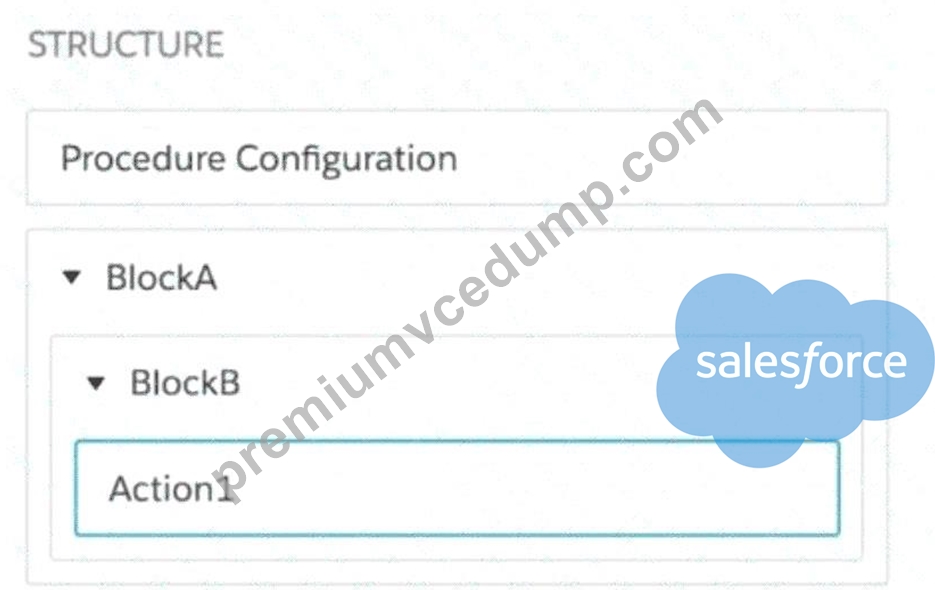
In this Integration Procedure structure, which Send JSON Path should be used to send the output of the Action1 element to a Remote Action?
- A. BlockA:BlockB:Action1
- B. Action1.BlockB.BlockA
- C. BlockA.BlockB.Action1
- D. Action1:BlockB:BlockA
Answer: C
Explanation:
In OmniStudio Integration Procedures, when you want to reference the output of an element in a nested block (e.g., for use in a Remote Action or another step), you must use dot notation that mirrors the block structure hierarchy.
In the exhibit:
* Action1 is nested inside:
* BlockB, which is nested inside:
* BlockA
Therefore, the correct Send JSON Path to access the result of Action1 is:
CopyEdit
BlockA.BlockB.Action1
This format complies with the standard output reference syntax in Integration Procedures, which follows the pattern:
php-template
CopyEdit
<ParentBlock>.<ChildBlock>.<ActionElement>
Incorrect Options:
* B. BlockA:BlockB:Action1 - Uses colons instead of dots. This is invalid syntax in JSON path resolution within Integration Procedures.
* C. Action1:BlockB:BlockA - Incorrect order and invalid separators.
* D. Action1.BlockB.BlockA - Incorrect order (reversed path).
Reference:
Salesforce OmniStudio Developer Guide # Integration Procedure Element JSON Pathing Best Practices for Send JSON Path # Nested Blocks and Element Referencing
NEW QUESTION # 42
Refer to the exhibit.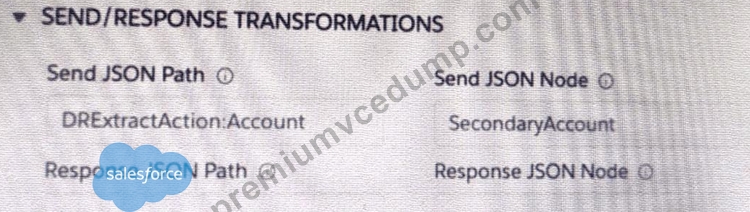
A developer has configured an integration Procedure element with SEND/RESPONSETRANFORMATIONS as shown.
Alternatively, how could the developer configure Additional input to send exactly the same data? Assume that the developer checked Send Only Additional input.
- A.

- B.

- C.

Answer: B
Explanation:
Option C is the correct way to configure Additional input to send exactly the same data as Input Data. The Additional input should have a key/value pair for each field in Input Data, and the value should be set to
{{InputData.field}} for each field. This will pass the value of Input Data for each field to Additional input.
NEW QUESTION # 43
When launching an OmniScript from an action on a FlexCard, the OmniScript displays, but no Salesforce data is populated:
Which two errors could cause this behavior?
Choose 2 answers
Choose 2 answers
- A. There is non active version of the OmniScript
- B. In the DataRaptor Extract Action, the Input Parameters Filter Value is misspelled.
- C. There is no active version of the Data Raptor Extract.
- D. The Id Field for Actions in the FlexCard is blank.
Answer: B,D
Explanation:
The Id Field for Actions in the FlexCard specifies which field from the FlexCard data source will be used as the record ID for the OmniScript. If this field is blank, the OmniScript will not receive any record ID and will not be able to retrieve any Salesforce data. In the DataRaptor Extract Action, the Input Parameters Filter Value determines how to filter the data based on the record ID. If this value is misspelled, the DataRaptor Extract will not be able to match the record ID and will not return any data.
NEW QUESTION # 44
A developer is creating a FlexCard and needs to display additional information using a Flyout.
Which two types of components can the developer embed in the flyout?
Choose 2 answer
- A. An OmniScript
- B. An Integration Procedure
- C. A DataRaptor
- D. A Child FlexCard
Answer: A,D
Explanation:
An OmniScript and a Child FlexCard are both valid components that can be embedded in a flyout. An Integration Procedure and a DataRaptor are not components, but actions that can be performed within an OmniScript or a FlexCard.
NEW QUESTION # 45
A developer creates an Integration Procedure with a Set values and a DataRaptor Extract Action that requires Accountld as a key. When the developer previews the Integration Procedure, the developer enters the Accountld correctly and executes the preview. The developer sees the dataextracted by the DataRaptor in the Debug Log, but the response is empty.
What is the likely cause of this issue?
- A. A Response Action was not added to the Integration Procedure.
- B. The Response cannot be previewed directly.
- C. The Accountld used for the preview is invalid.
- D. The DataRaptor Action did not have the Add Response To Response JSON property set to true.
Answer: D
Explanation:
The Add Response To Response JSON property on the DataRaptor Action indicates that the output of the DataRaptor should be added to the response JSON of the Integration Procedure. If this property is not set to true, the response will be empty even if the DataRaptor extracts data successfully.
NEW QUESTION # 46
A developer configures a FlexCard with a Data Mapper data source that uses the params.id as an input. When the developer clicks "View Data" on the FlexCard, valid data displays. However, when the developer previews the layout, the FlexCard does not display.
What could cause this error?
Choose 2 answers
- A. The RecordId in the Test Data Source Settings is for the wrong record type.
- B. The Data Node field for the FlexCard is empty.
- C. There is no Salesforce record for the FlexCard based on the RecordId in the layout's Test Data Source Settings.
- D. The Attributes haven't been configured to pass the data to the fields.
Answer: B,C
Explanation:
This scenario relates to FlexCard preview behavior and data mapping issues.
* B. There is no Salesforce record for the FlexCard based on the RecordId in the layout's Test Data Source Settings - If the test record does not exist, the FlexCard will not display any data during preview. This is a common setup mistake.
* C. The Data Node field for the FlexCard is empty - The Data Node field must be set correctly to match the JSON node where the expected data resides. If it is empty or incorrect, the FlexCard won't bind data to UI elements.
Incorrect Options:
* A. Even if the RecordId is from a different record type, as long as the data structure aligns, it would still render; it's not a definitive reason for the card failing to display.
* D. Attributes are not required to display field values directly; they are used for passing data between cards or from context, not for direct field rendering.
:
Salesforce OmniStudio # FlexCard Data Source Setup & Troubleshooting
NEW QUESTION # 47
A customer sets up two LWC OmniScripts, one embedded into another. AccountId is set in a Set Values element in the parent OmniScript. The Accountid set in the parent OmniScript is used to set another Set values element ContextAccountId in the emvedded OmniScript. The embedded OmniScript is activated.
While previewing the OmniScript flow from the parent, it is found that Account I set correct in the parent OmniScript. However, ContextAccount in the embedded OmniScript is not set with the Accountid from parent OmniScript. On previewing the embedded OmniScript individually. It is found that ContextAccountId is set correctly.
What is the reason for this? Refer to the exhibit below.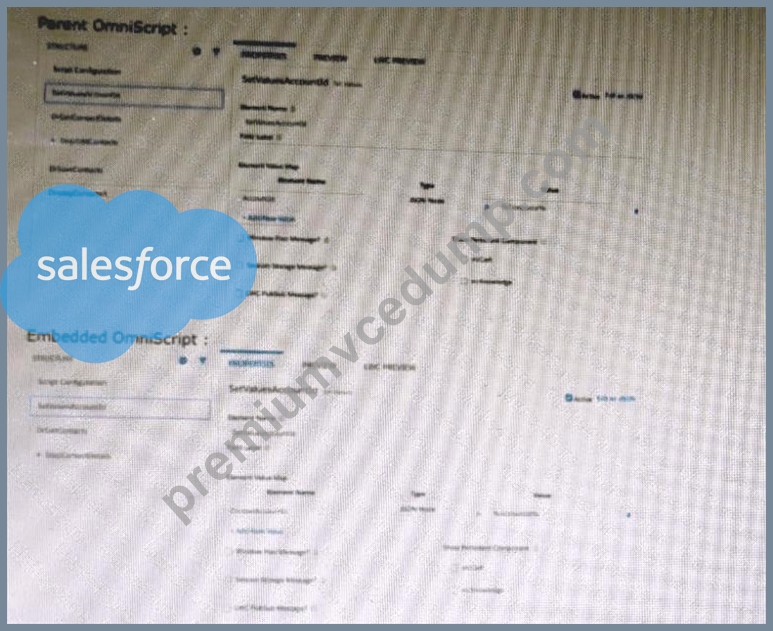
- A. A developer failed to includea Navigate Action Element to pass data from the parent OmniScript.
- B. The WLC PubSub Messge flag in the Set Values action of the parent OmniScript has not been set.
- C. Both parent and embedded OmniScripts have the same element name for the Set Values element.
- D. The flag passData.JSON in the parent OmniScript in not configured correctly.
Answer: B
Explanation:
The LWC PubSub Message flag in the Set Values action of the parent OmniScript enables the parent OmniScript to send data to the embedded OmniScript using a custom event. If this flag is not set, the data will not be passed to the embedded OmniScript
NEW QUESTION # 48
In an Integration Procedure, a developer needs to perform a multi-step calculation on every element of an array.
Based on best practices, what two methods are recommended?
Choose 2 answers
- A. Use a Matrix Action to call a Calculation Matrix.
- B. Use a List Action to merge the array elements together.
- C. Use a Set Values Element inside a Loop Block.
- D. Use a Calculation Action to call a Calculation Procedure.
Answer: A,D
Explanation:
According to the Integration Procedure Actions page, a Calculation Action can be used to "call a Calculation Procedure that performs calculations on input data" and a Matrix Action can be used to "call a Calculation Matrix that performs calculations on input data".
NEW QUESTION # 49
A developer examines data received from an external data source. The data is nested two levels down in the JSON structure.
Which OmniStudio tool could the developer use to simplify this data?
- A. Integration Procedure
- B. Guided Workflow
- C. Data Mapper Transform
- D. HTTP Action Element
Answer: A
Explanation:
According to Salesforce OmniStudio Integration Procedures documentation, when working with deeply nested JSON, Integration Procedures are ideal. They allow developers to flatten and manipulate JSON data, especially when handling external responses.
* C. Integration Procedure - This is correct. IPs provide Response Transformers, DataRaptor Transforms, and Response Actions to reshape and simplify nested data structures for consumption by front-end components.
Incorrect Options:
* A. DataRaptor Transform is used inside IPs but cannot directly handle external HTTP calls or manage complex orchestration.
* B. HTTP Action Element is used inside an Integration Procedure, but by itself, it does not process or simplify the data.
* D. Guided Workflow is not a recognized OmniStudio component for data transformation.
:
OmniStudio Integration Procedures Guide # Handling Nested JSON
NEW QUESTION # 50
......
Provide Valid Dumps To Help You Prepare For Salesforce Certified Omnistudio Developer Exam: https://examsites.premiumvcedump.com/Salesforce/valid-Plat-Dev-210-premium-vce-exam-dumps.html