

Latest ACD201 Practice Test Questions Verified Answers As Experienced in the Actual Test!
Pass Appian ACD201 Exam in First Attempt Easily
Appian ACD201 Exam Syllabus Topics:
| Topic | Details |
|---|---|
| Topic 1 |
|
| Topic 2 |
|
| Topic 3 |
|
| Topic 4 |
|
NEW QUESTION # 20
You're creating an interface to display all the employees of a company on a staff list.
You decide to use a!gridField() to create a user grid to display information from the company's AAA_Employee record, which has 42 fields relating to various employee information. To avoid cluttering the grid, you want to show six (6) fields on the grid.
How should you optimize the interface?
- A. Using a local variable, query the AAA_Employee record using a!queryRecordType(), without defining the six (6) fields you require to show in the "fields" parameter to be used in the data parameter of a!
gridFieid(). - B. Call the function a!forEach() in a local variable and query the AAA_Employee for each employee separately by using a!queryRecordType() to loop through all employees as defined by a constant to be used in the data parameter of a!gridFieid().
- C. Query the AAA_Employee record using a!queryRecordType(), defining the six (6) fields you require to show in the "fields" parameterto be used in the data parameter of a!gridFieid().
Answer: C
Explanation:
Querying the AAA_Employee record with a!queryRecordType(), specifying only the six fields needed in the fields parameter, optimizes data retrieval and improves grid performance by minimizing unnecessary data loading.
NEW QUESTION # 21
You're creating a synced record type which will store read-only data from an external web service. Data in the external system is updated nightly, and the latest information must be available to users in the morning.
Currently there are approximately 150,000 entries in the external system, and this number is not expected to change significantly.
There is an existing integration object and associated expression rule, which when called returns the complete dataset from the external system.
What are two configurations that you must apply to ensure that the latest and complete record set is available?
(Choose two.)
- A. Within the Source Filters settings on the record type, disable the row limit option so that all entries can be retrieved from the external system.
- B. Set all record fields to evaluate in real-time so that the latest information is always retrieved from the web service.
- C. Modify the integration object and associated expression rule to return batches of 1000 based on a batch number passed in from the record type.
- D. Within the record type, schedule a full sync to occur nightly after the data is refreshed in the external system.
Answer: A,D
Explanation:
Scheduling a nightly full sync ensures the record type is updated with the latest data after the external system refreshes.
Disabling the row limit in Source Filters allows the complete dataset to be retrieved and synced, ensuring all entries are available.
NEW QUESTION # 22
You're executing a performance test of the client's application. You notice that server-side resources are at high-to-critical operating levels.
What should you do to troubleshoot this issue?
Note: To answer, move all steps from the Options list to the Answer List area and arrange them in the correct order.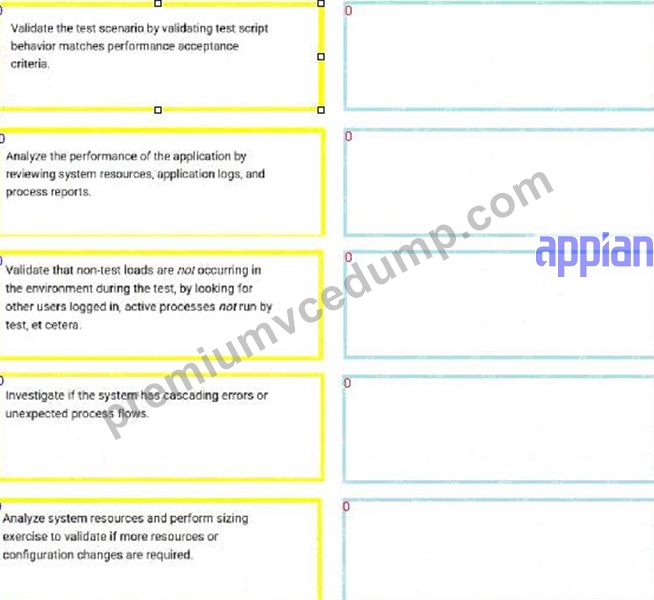
Answer:
Explanation: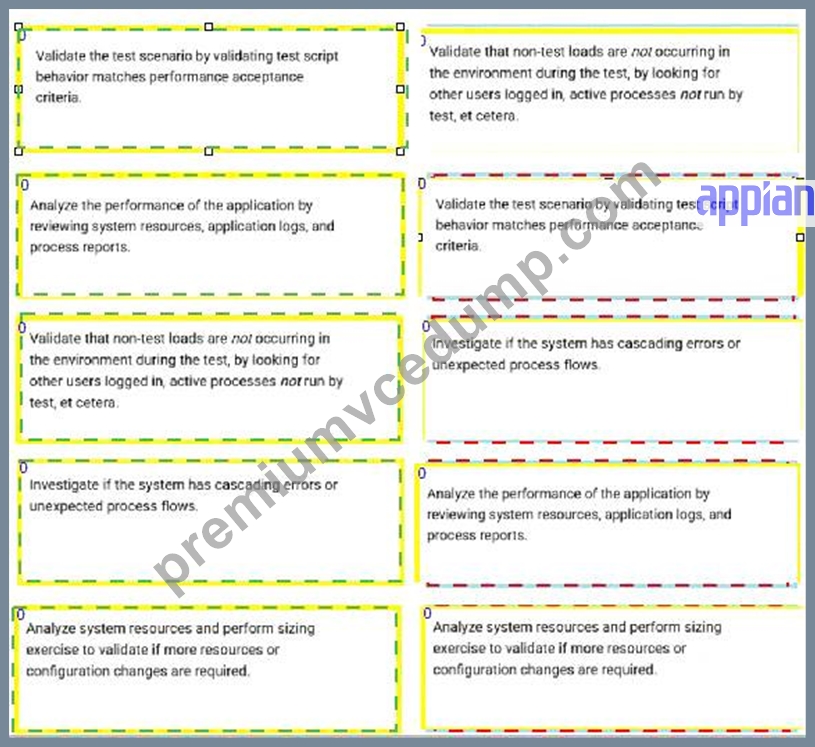
Explanation: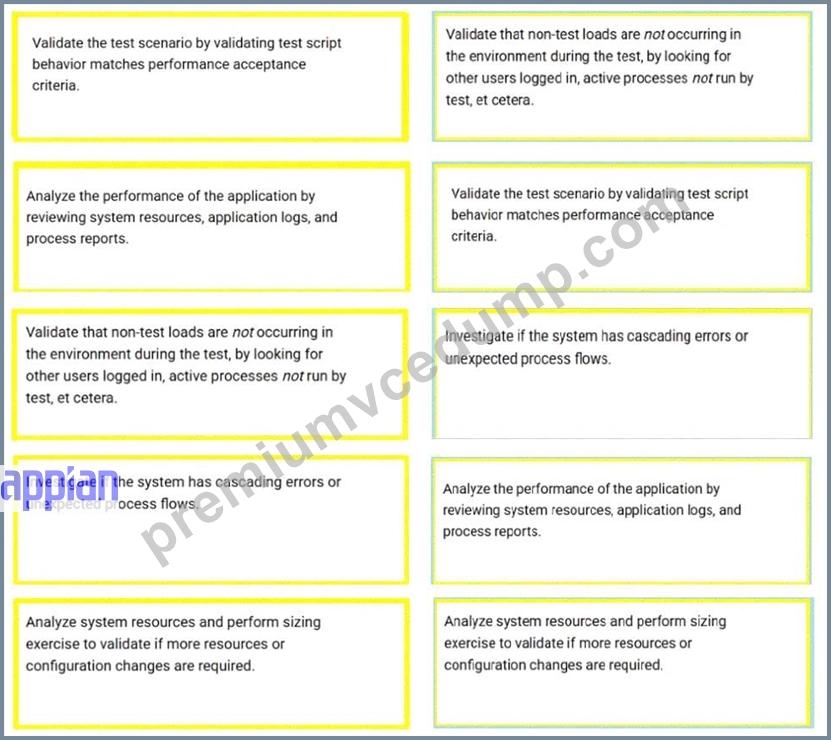
NEW QUESTION # 23
The synced record Task has a self-referential relationship defined in the column parentTaskId. There is a many-to-one record relationship between the id and parentTaskId called parentTask.
For a given task ID, you need to return the task name and the parent task name.
What should you do?
- A. Create a sync-time custom record field on the Task record called parentName. Specify this field to return in the query field selection.
- B. Use a!queryRecordType() filtered on the task id once to return the task name and parent task ID. Query the record again to return the parent task name.
- C. Use a!queryRecordType() with a filter on the task id, with fields specified to return recordType!Task.name and recordType!Task.parentTask.name.
Answer: C
Explanation:
Using a!queryRecordType() with a filter on the task ID and specifying both recordType!Task.name and recordType!Task.parentTask.name in the fields will efficiently return both the task name and its parent task name in a single query.
NEW QUESTION # 24
What are two advantages of database normalization? (Choose two.)
- A. Enforcing data integrity.
- B. Minimizing data redundancy.
- C. Minimizing the number of tables that need to be created.
- D. Simplifying query statements to read data.
Answer: A,B
Explanation:
Database normalization enforces data integrity by structuring data and relationships to prevent anomalies.
It minimizes data redundancy by ensuring each piece of information is stored only once, reducing duplication.
NEW QUESTION # 25
You're developing a case management application. Currently, users can view a list of all cases designed using a a!forEach() loop from a record query. Users can navigate to the case summary page which shows the case details in a two (2) column layout. Users are also able to update the case details.
During the last round of UAT testing, users reported that the tool was not intuitive to use.
Match each feedback comment to the suggested UI/UX improvements.
Note: Each UI/UX improvement will be used once, or not at all. To change your responses, you may deselect your response by clicking the blank space at the top of the selection list.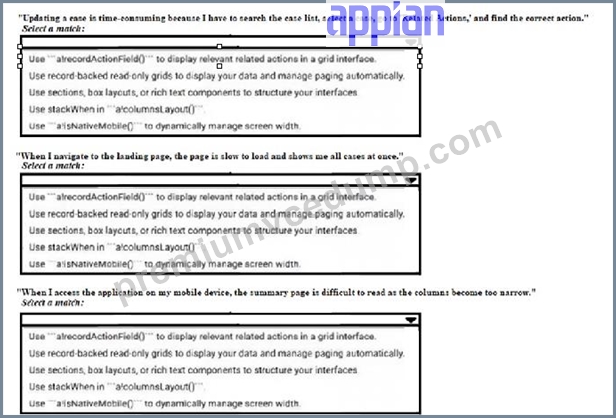
Answer:
Explanation: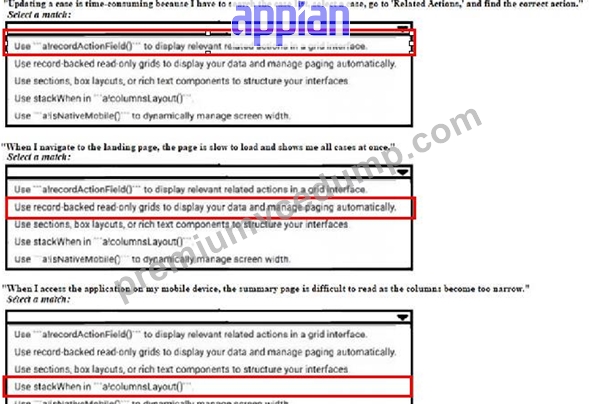
NEW QUESTION # 26
You need to update an existing Appian application.
The application needs to be responsive and compatible with a variety of screen widths. For example: phone/tablet browser, Appian mobile app, desktop monitor.
Which two functions/parameters should you consider when updating the interfaces? (Choose two.)
- A. stackWhen in Columns Layout and Side By Side Layout
- B. Width of a page in the site object
- C. a!isNativeMobile()
- D. a!isPageWidth()
Answer: A,C
Explanation:
The stackWhen parameter in layout components helps interfaces adapt to different screen sizes by controlling when columns or side-by-side layouts stack vertically.
The a!isNativeMobile() function detects if the interface is being viewed on a native mobile app, allowing you to tailor the interface for mobile responsiveness.
NEW QUESTION # 27
You're the administrator of your insurance company's case management system. You need to limit insurance agents to only those clients to which they have been assigned.
Which two statements must be true for one way to configure Record-Level security for the Customer record?
(Choose two.)
- A. A condition should be added to the record-level security rule to specify which cases specifically named agents can access.
- B. Data sync should be enabled.
- C. Record-level security means agents must have permission to view the record type and permission to edit the records.
- D. A new record-level security rule should be created using the Users found in fields option to specify that if a user is found in the "assignedAgent" field (which is a type User), then they can see their cases.
Answer: A,D
Explanation:
Creating a record-level security rule using the "Users found in fields" option ensures agents only see records assigned to them through the "assignedAgent" field.
Adding a condition to the rule further refines which records (cases) each agent can access, implementing precise record-level security.
NEW QUESTION # 28
You're performing System Integration Testing on a client's application that integrates with an external system.
In this instance, you're testing the application's interactions with external integrations to ensure that data is being handled correctly between the two systems. However, this step has been done manually and is time- consuming.
What should you do to make this process more efficient?
- A. Utilize Appian-Locust to develop and execute performance tests on the systems integrations by scripting a scenario where multiple users are interacting with the external systems simultaneously.
- B. Utilize FitNesse for Appian to perform automated functional testing on the workflows that include integrated systems through a defined set of test cases.
- C. Utilize the Postman API Platform to test the integrations with the external system and Appian's web APIs through a defined set of test cases.
Answer: B
Explanation:
FitNesse for Appian is designed for automated functional testing of Appian workflows, including those that call external integrations. By building repeatable FitNesse test scripts that drive the end-to-end process, you can automatically verify that data is correctly sent to - and returned from - the external system each time, greatly reducing the manual effort of system-integration testing.
NEW QUESTION # 29
You're creating a process model that will serve as the case creation workflow.
Your requirements:
This process captures input from the user before executing a series of unattended subprocess nodes.
Each subprocess performs extended data processing which is dependent on output from each of the previous nodes.
An activity chained task node is displayed asking the user if they'd like to create another case.
What should you do?
- A. Configure the subprocess nodes to run asynchronously and set the inputs to pass as reference to enable data sharing.
- B. Combine the separate subprocesses into one synchronous subprocess and place it in between each user input task.
- C. Add an AND gate after the first user input task and place the synchronous subprocess nodes on a parallel path.
Answer: B
Explanation:
Combining the separate subprocesses into one synchronous subprocess and placing it between each user input task ensures each subprocess's output is available for the next step, maintaining data dependencies and supporting the required user experience with activity chaining.
NEW QUESTION # 30
You need to create a process workflow for employee background investigations. This workflow takes an average of six months from start to completion. There are multiple phases to the background investigation which must be completed by people in different departments. Each department is responsible for inputting a large amount of data as part of the workflow.
There is an emphasis on process memory management since thousands of these investigations will happen concurrently.
What are two best practices that you should employ when designing this process workflow? (Choose two.)
- A. Combine all stages of the workflow into a single process model, so that data can be efficiently shared between nodes using process variables.
- B. Divide the workflow into multiple process models so that each process can be short-lived and consume less memory.
- C. Utilize a record-backed design throughout the workflow where data entered by users is saved to and queried from the database.
- D. Ensure that the data management policy is set to archive the process instances after a minimum of six months, so that data is available throughout the workflow.
Answer: B,C
Explanation:
Using a record-backed design ensures data is persisted in the database, not held in memory, optimizing process memory management.
Dividing the workflow into multiple process models allows each to be short-lived, further reducing memory usage and improving scalability.
NEW QUESTION # 31
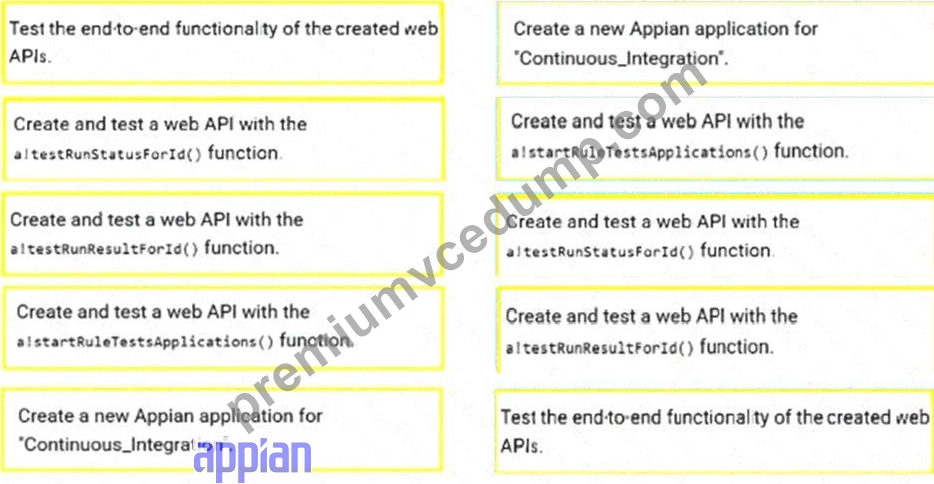
Your development team has selected Jenkins as a Continuous Integration (CI) system to integrate testing of Appian into your overall testing strategy.
What should you do to set up automated testing of expression rules using Jenkins?
Note: To answer, move all steps from the Options list to the Answer List area and arrange them in the correct order.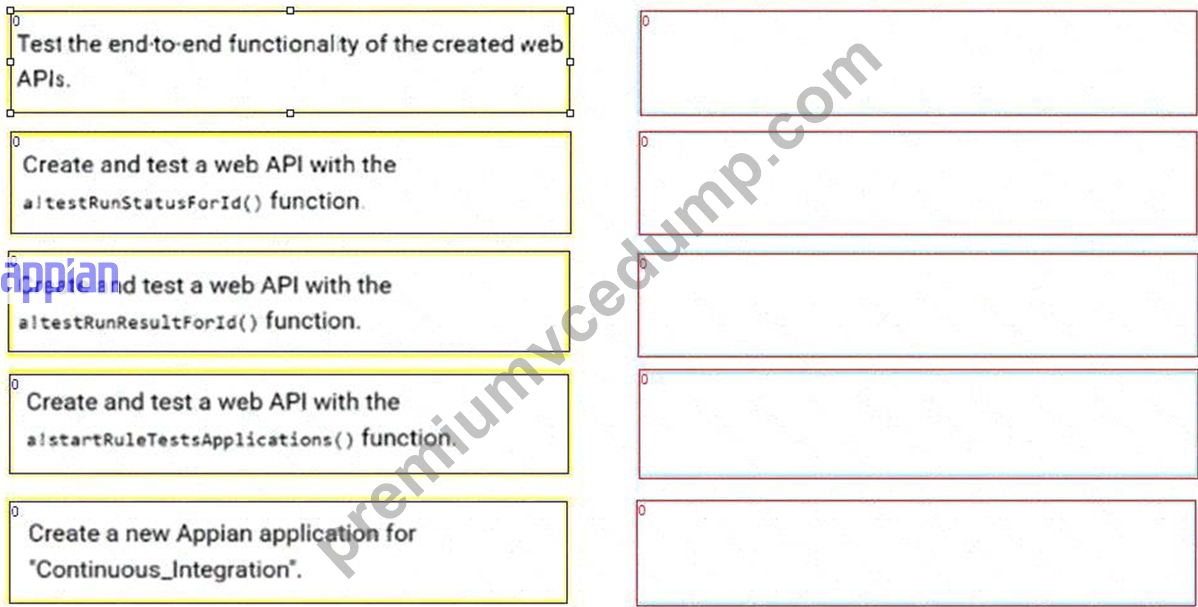
Answer:
Explanation: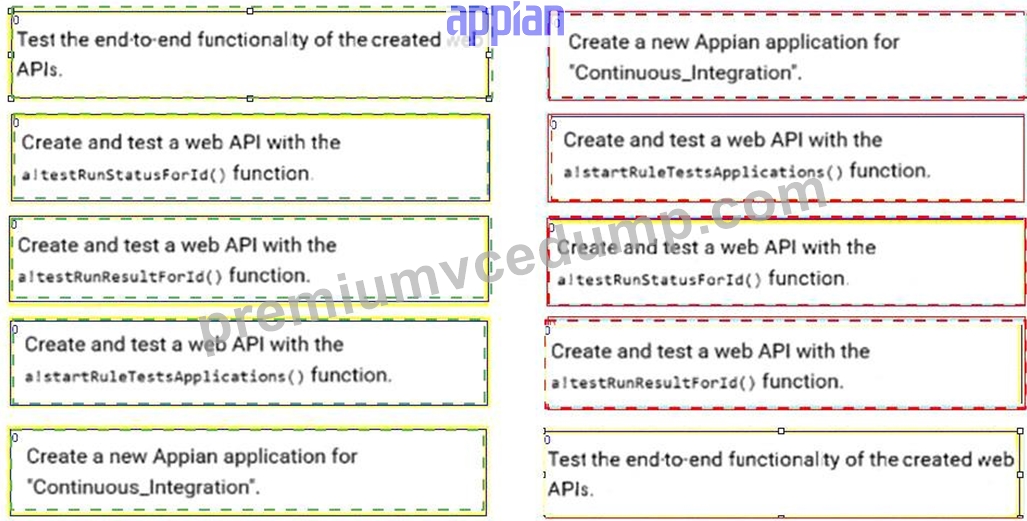
NEW QUESTION # 32
An application consists of a record type with sync enabled. This record type is used as a source to create a read-only grid.
A field "Number of days since created" is configured in the interface and a logic is implemented to calculate the number of days since a record is created in the application.
You need to implement sorting on this field.
What should you do?
- A. Add sortField: "Number of days since created" configuration for the gridColumn that needs to be sorted.
- B. Sorting is not possible on custom record type fields. Instead, create a view with a custom field and use the field from the view for sorting.
- C. Create a custom record type field and use it in the sorting configuration.
Answer: C
Explanation:
Creating a custom record type field to calculate "Number of days since created" allows you to use this field in the sorting configuration of your read-only grid.
NEW QUESTION # 33
You're creating a support case record type while working on a support case management system. You want to track support case status changes.
You want to use record events to track this information.
Which record data source type is the most appropriate for you to use?
- A. Web service without data sync enabled
- B. Process Model source with data sync enabled
- C. Database source with data sync enabled
Answer: C
Explanation:
A database source with data sync enabled is required to use record events for tracking support case status changes, as Appian record events are only supported for synced record types with a database as the data source.
NEW QUESTION # 34
Which section of the Interface Performance View explains the contribution towards the overall evaluation time of the current function, rule, or parameter?
- A. Descendant Rules
- B. Precedent Functions and Rules
- C. Parameters and Direct Children
Answer: C
Explanation:
The "Parameters and Direct Children" section of the Interface Performance View explains the contribution towards the overall evaluation time of the current function, rule, or parameter.
NEW QUESTION # 35
You need to create an expression rule that will be reused throughout your environment.
What are two reasons why you should include meaningful test cases when creating a new expression rule?
(Choose two.)
- A. To facilitate Test-Driven Development.
- B. To improve the performance of the environment.
- C. To accelerate various types of testing, including: unit, regression, exploratory.
- D. To enhance the appearance of the code.
Answer: A,C
Explanation:
Meaningful test cases accelerate different testing types by providing clear validation scenarios for the rule.
They support Test-Driven Development by enabling you to define expected outcomes before or during rule creation.
NEW QUESTION # 36
What are three ways to optimize the memory usage of a process model? (Choose three.)
- A. Configure process variables as parameters.
- B. Decrease the number of process variables.
- C. Divide large nodes into multiple smaller nodes.
- D. Minimize the use of subprocesses in the model.
- E. Avoid storing large blocks of text in process variables.
- F. Pass data directly to activity nodes and smart services.
Answer: A,E,F
Explanation:
Passing data directly to activity nodes and smart services reduces unnecessary use of process variables, optimizing memory.
Configuring process variables as parameters limits their lifespan and persistence, saving memory.
Avoiding large blocks of text in process variables minimizes memory consumption within the process model.
NEW QUESTION # 37
A local variable is reevaluated every time a form loads and you notice subsequent slow performance of the form.
Which two steps could you perform to optimize this? (Choose two.)
- A. Ensure the local variable is refreshed after a specified interval, and nor refreshed when referenced variable are changed.
- B. Ensure the local variable only updates when a referenced variable is modified or when it's being updated in the saveInto parameter of a component.
- C. Avoid executing queries every time a form reevaluates.
- D. Create a local variable inside with () for faster reevaluation.
Answer: B,C
Explanation:
Avoiding queries on every form reevaluation prevents unnecessary data retrieval and improves form performance.
Ensuring the local variable only updates when necessary (e.g., on relevant variable changes or via saveInto) reduces redundant recalculations and optimizes responsiveness.
NEW QUESTION # 38
Match each action you want to perform to the appropriate log type.
Each log type will be used once or not at all. To change your responses, you may deselect your response by clicking the blank space at the top of the selection list.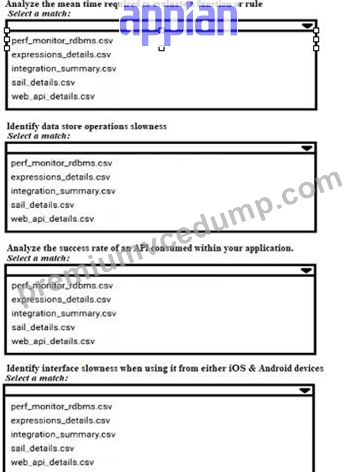
Answer:
Explanation: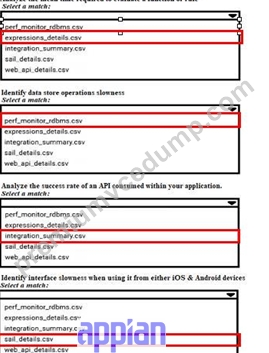
NEW QUESTION # 39
You need to connect to an external system using OAuth 2.0: SAML Bearer Assertion Flow authentication type, which requests access to an API on of a signed in user.
This standard has several steps involved with the SAML Bearer Assertion Flow.
Which two steps should you perform to connect to the external system? (Choose two.)
- A. Use an a!authorizationLink() on the relevant interface.
- B. Register the connection in the third-party system
- C. Generate a service account key in third-party systems.
- D. Confiqure SAML for sinqle siqn-on (SSO).
Answer: B,D
Explanation:
Configure SAML for single sign-on (SSO).
The bearer-assertion flow relies on an existing SAML SSO configuration so Appian can issue a signed SAML assertion on behalf of the signed-in user.
Register the connection in the third-party system.
You must register (or "trust") Appian's client/certificate with the external system so it will accept the SAML assertion and issue an OAuth 2.0 access-token for the user.
NEW QUESTION # 40
Consider this POST request:
https://www.example.com/suite/webapi/customer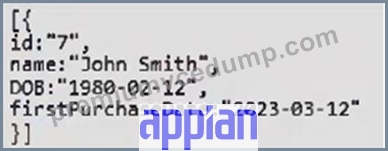
Match the values to the correct fields in the resulting http!request value.
Note: Each value will be used once. To change your responses, you may deselect your response by clicking the blank space at the top of the selection list.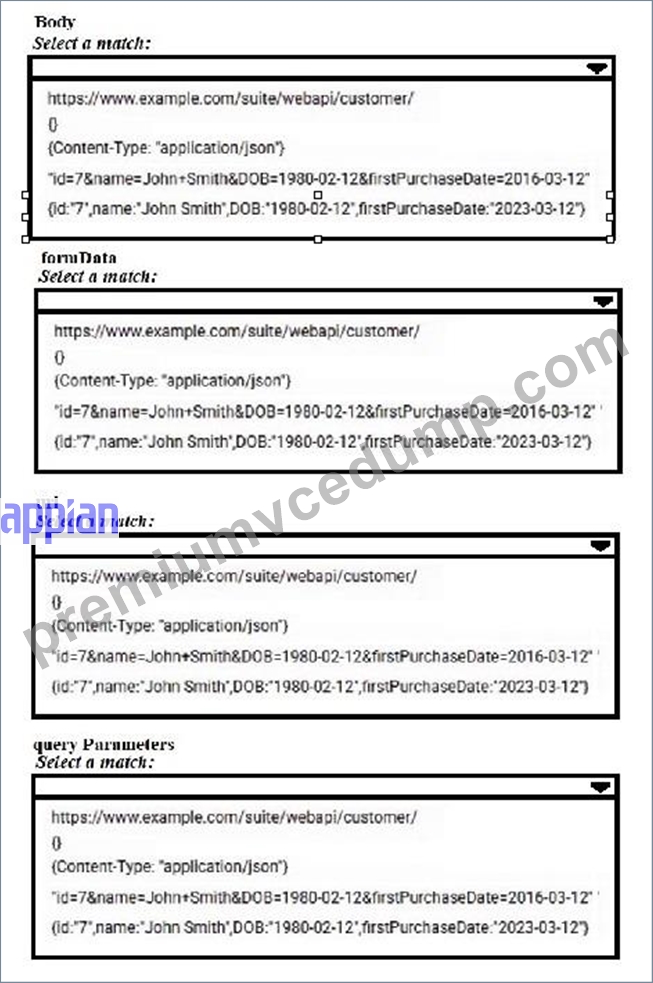
Answer:
Explanation: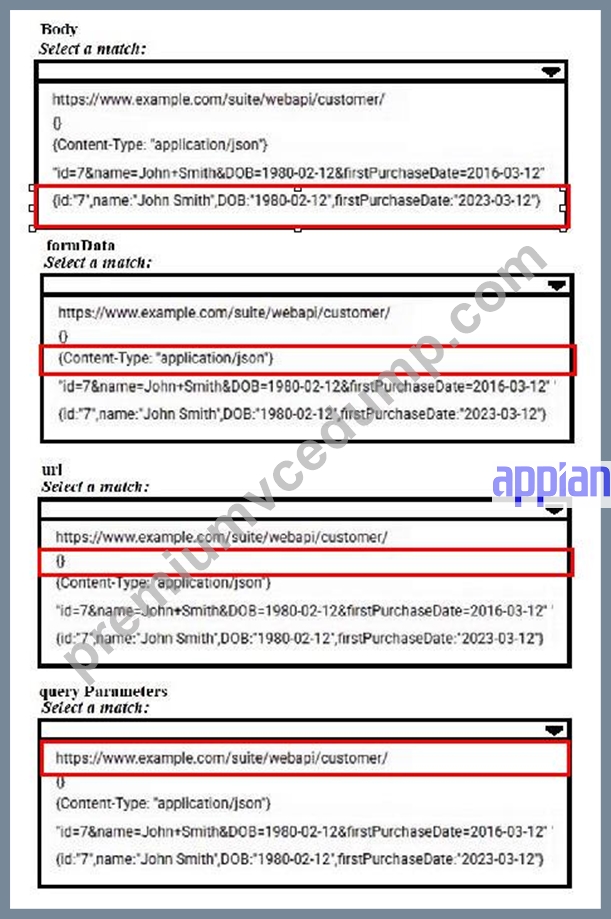
NEW QUESTION # 41
You need to configure Appian user authentication against an external directory server. The requirement is to use the same corporate logon information without single sign-on (SSO).
Which authentication type should you use?
- A. OpenID Connect authentication
- B. LDAP authentication
- C. PIEE user authentication
Answer: B
Explanation:
LDAP authentication allows users to log in with their corporate credentials by authenticating against an external directory server, without requiring single sign-on (SSO).
NEW QUESTION # 42
......
We offers you the latest free online ACD201 dumps to practice: https://examsites.premiumvcedump.com/Appian/valid-ACD201-premium-vce-exam-dumps.html